
Claude vs ChatGPT vs Gemini 2026: Full Data-Backed Comparison
Every “Claude vs ChatGPT vs Gemini” post you’ve read probably compares models that don’t even exist anymore. That’s the real problem with AI content in 2026 — the industry ships a new flagship every 6-8 weeks, and most comparison articles are just recycled screenshots from three model generations ago.
This one isn’t. Every number below is pulled directly from Anthropic, OpenAI, and Google’s own pricing pages, plus independent leaderboards like LMArena and Artificial Analysis — all checked on July 4, 2026. Where a figure is still unofficial or in flux (looking at you, Gemini 3.5 Pro), I’ve flagged it instead of pretending it’s settled.
What Is Claude, ChatGPT, and Gemini — In One Line Each
- Claude (Anthropic) positions itself around coding, agentic reliability, and safety — its current default consumer model is Claude Sonnet 5, launched June 30, 2026.
- ChatGPT (OpenAI) is the largest consumer AI product by reach, currently running on GPT-5.5 in the public app, with the next-gen GPT-5.6 family (Sol/Terra/Luna) in limited partner preview only.
- Gemini (Google) leans on native Google ecosystem integration (Gmail, Docs, Search) and currently offers the largest context window in production — Gemini 3.1 Pro at 2M tokens.
Head-to-Head: The Data Table
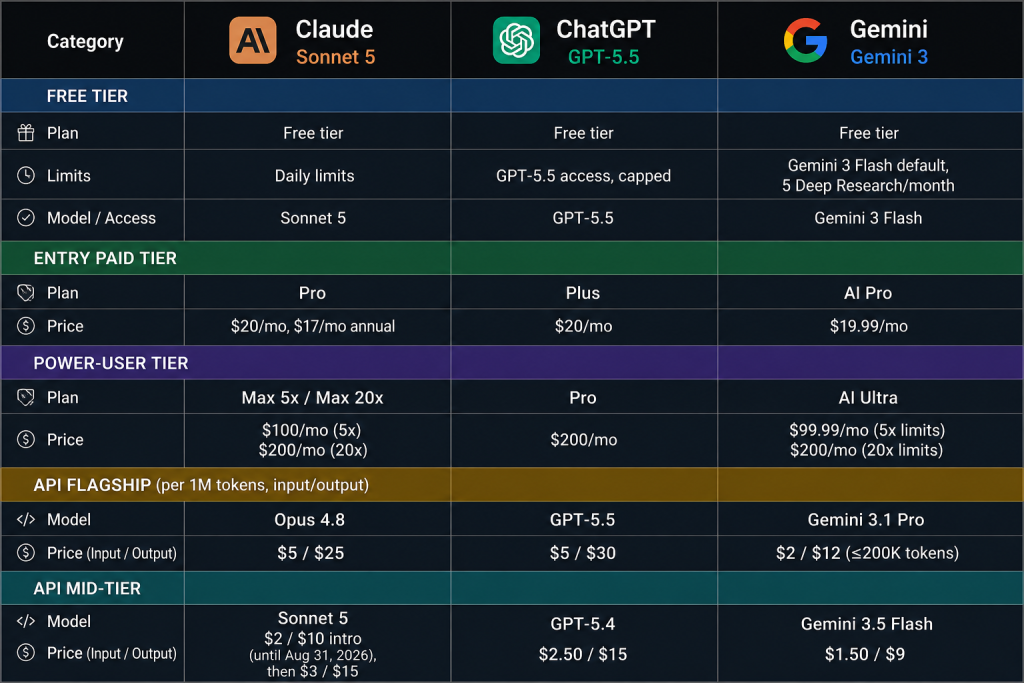
Sources: Anthropic Claude Sonnet 5 announcement and Pricing Docs (claude.com/pricing, platform.claude.com); OpenAI API Pricing (developers.openai.com/api/docs/pricing) and ChatGPT Pricing page (chatgpt.com/pricing); Google Cloud Gemini pricing (cloud.google.com) and Google I/O 2026 subscription blog post (blog.google). All accessed July 4, 2026. Independent benchmark figures from ofox.ai leaderboard, dated June 16, 2026 — the most recent third-party snapshot available at time of writing [flag: benchmark scores shift with nearly every model release, re-verify before quoting in client decks].
Strengths — What Each One Actually Does Well
Claude: Sonnet 5 was built specifically to close the gap with Anthropic’s own flagship at a fraction of the cost — on one internal benchmark it scored 63.2% on agentic coding versus Opus 4.8’s 69.2%, while costing roughly 40% less per token at standard pricing. Real-world testers, including a Zapier engineer cited in Anthropic’s own launch materials, reported it completing multi-step jobs (like updating CRM records and sending follow-up communications) end-to-end where earlier models stalled halfway.
ChatGPT: Distribution is OpenAI’s moat — ChatGPT remains free for anyone to try, with the Plus tier at $20/month unlocking GPT-5.5. The bigger story is GPT-5.6, previewed on limited partner access; OpenAI reports Terminal-Bench 2.1 scores of 88.8% for the Sol tier and 91.9% for “Sol Ultra” mode, which uses multiple subagents on harder tasks. [Flag: GPT-5.6 is not yet in the consumer ChatGPT app — OpenAI has only said broader access is “coming soon” with no confirmed date.]
Gemini: The 2-million-token context window on Gemini 3.1 Pro is the single biggest differentiator in the market right now — genuinely large enough to hold an entire codebase or a book-length document in one prompt. Gemini 3.5 Flash, meanwhile, actually beats the pricier 3.1 Pro on coding and agentic benchmarks (76.2% on Terminal-Bench 2.1) while costing about 25% less — an unusual case of the “cheap” tier outperforming the “premium” one.
Weaknesses — The Honest Part
Claude: No free-tier access to Opus-class reasoning; Opus 4.8 API pricing ($5/$25 per 1M tokens) is the most expensive of the three companies’ mainstream flagship tiers. Claude also has no native video/image generation comparable to Gemini’s Nano Banana or OpenAI’s image tools.
ChatGPT: GPT-5.6 — the model OpenAI is currently marketing hardest — simply isn’t available to regular users yet. It’s gated to roughly 20 partner organizations following coordination with the U.S. government under a June 2026 executive order on AI model benchmarking. If you’re comparing “ChatGPT” as an actual product you can open today, you’re comparing GPT-5.5, not the headline model in OpenAI’s own blog posts.
Gemini: Gemini 3.5 Pro — the model meant to carry the 2M-context, “Deep Think” flagship positioning forward — has slipped its release twice: first from a June target, now trailing into July 2026, and Google has not published its pricing or benchmark scores as of this writing. Anything you read about 3.5 Pro’s performance right now is a leak or an estimate, not a confirmed fact.
Which One Fits Your Use Case
Freelancers and solo marketers (Ashad, this is you): Claude Sonnet 5’s low cost-per-agentic-task and strong Hinglish/multilingual handling make it efficient for client deliverables — ad copy, JSON video prompts, landing page briefs — at $20/month on Pro. Gemini’s Workspace integration is worth it only if your workflow already lives inside Gmail/Docs/Sheets.
Coders and technical builders: Claude Opus 4.8 currently leads independently-verified SWE-bench Verified at 88.6%, ahead of GPT-5.5 (82.6%) and Gemini 3.5 Flash (78.8%). If you’re inside Claude Code, Sonnet 5 is the default and cheaper option; escalate to Opus only for the hardest refactors.
Students and researchers: Gemini’s Deep Research (up to 20 sessions/day on the $19.99/month AI Pro plan) plus the 2M context window on 3.1 Pro is genuinely useful for processing long papers or entire syllabi in one go.
Businesses needing long-document analysis: Gemini 3.1 Pro’s 2M-token window is unmatched in production right now — nothing from Claude or OpenAI comes close at GA (general availability) stage.
The Verdict
There’s no honest “it depends” cop-out here once you actually look at the numbers: for cost-efficient agentic work and coding, Claude wins on price-to-performance. Sonnet 5 at $2-3 per million input tokens delivering Opus-class results on multiple benchmarks is the strongest value proposition of the three right now.
For raw context length and Google-ecosystem workflows, Gemini wins — the 2M-token window on 3.1 Pro has no equivalent at general availability from either competitor.
For sheer accessibility and brand-name trust with non-technical users, ChatGPT wins — it’s still the product most people default to opening first, even though its actual next-gen model (GPT-5.6) isn’t in their hands yet.
If you’re a freelancer or marketer choosing just one tool to build a workflow around in mid-2026: start with Claude for execution-heavy client work, keep Gemini free-tier open for quick Google-Docs-native tasks, and don’t pay for GPT-5.6 hype until it’s actually shipped to your account.
FAQ
Is Claude better than ChatGPT for coding in 2026? On independently verified benchmarks, Claude Opus 4.8 leads SWE-bench Verified at 88.6% compared to GPT-5.5’s 82.6%, as of the June 16, 2026 ofox.ai leaderboard snapshot. For day-to-day coding at lower cost, Claude Sonnet 5 offers comparable results to Opus 4.8 on several agentic tasks at roughly 40% lower per-token pricing.
How much does Claude Pro cost in India? Claude Pro is priced at $20/month globally ($17/month if billed annually), per Anthropic’s official pricing page, accessed July 4, 2026. India-specific pricing in INR isn’t separately published by Anthropic; users are billed in USD via card, subject to normal foreign-transaction fees from Indian banks.
Is Gemini 3.5 Pro released yet? No — as of July 4, 2026, Gemini 3.5 Pro remains in limited enterprise preview on Vertex AI. Google announced it at I/O on May 19, 2026, targeting a June release that slipped to July; no public pricing or benchmark data has been confirmed by Google as of this writing.
Which AI has the biggest context window? Gemini 3.1 Pro, at 2 million tokens, per Google Cloud’s official pricing documentation. This is double Claude’s 1M-token window (Sonnet 5, Opus 4.8) and roughly double ChatGPT’s ~1.05M-token window on GPT-5.5.
